





From Friction to Flow: Reframing Workplace Conflict
Ask any manager what their least favorite part of the job is, and “dealing with interpersonal conflict” will almost certainly top the list. For decades, the conventional wisdom in corporate culture has been to suppress conflict at all costs. We are told to “keep the peace,” “avoid waves,” and “play nice.“
But here is the uncomfortable truth that top-performing organizations already understand: A workplace with zero conflict is not a healthy workplace—it’s a stagnant one.
When disagreements are completely absent, it rarely means everyone is happy. More often, it means employees are too disengaged or too fearful to share their best ideas, voice concerns, or challenge outdated processes.
The soft skill that separates high-performing managers from the rest is not the ability to avoid conflict, but the ability to reframe and utilize it.
Task Conflict vs. Relationship Conflict
To leverage conflict successfully, we must first understand the two primary types of disagreement that occur at work:
-
Relationship Conflict (The Toxic Kind): This is the conflict we rightly fear. It is personal, emotional, and centered on personalities rather than production. It manifests as eye-rolling, passive-aggressive emails, gossiping, and disrespect. This type of conflict always destroys productivity.
-
Task Conflict (The Productive Kind): This is the conflict we must learn to embrace. It is disagreement over the substance of the work—the strategy, the project deadline, the specific line of code, or the marketing campaign’s direction. This is the friction that precedes innovation.
The goal of conflict management training is not to create a consensus-only environment, but to ensure relationship conflict is minimized and task conflict is managed professionally.
Reframing: Turning Arguments Into Collaboration
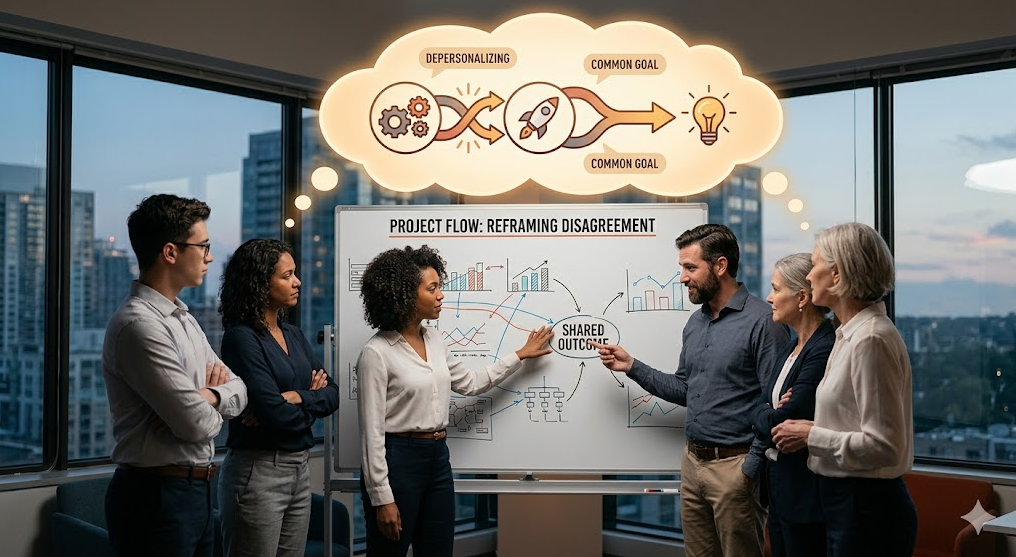
Reframing conflict requires high levels of emotional intelligence and deliberate communication strategies. It means shifting the objective of the conversation from “I need to win” to “We need to solve a problem.”
Here are three core strategies taught in modern conflict resolution training to transition teams from friction to flow:
1. Depersonalize the Issue: Focus on the “What,” Not the “Who” The moment a disagreement becomes personal, productiveness ends. A skilled manager reframes relationship conflict into task conflict by pulling the conversation back to objective data.
-
Instead of: “You are always late with these reports.” (Relationship)
-
Try: “When this report arrives past 3 PM, it causes a bottleneck for the compliance team. Let’s look at the current workflow constraints.” (Task)
2. Shift from “Yes, But” to “Yes, And” In a typical workplace debate, we listen only to find the flaw in the other person’s argument. As soon as they finish, we jump in with “Yes, but…” (which really just means “I’m invalidating everything you just said”).
A more collaborative approach is borrowing the primary rule of improvisation: “Yes, and…” This phrase validates their perspective and builds upon it, even if you disagree. It creates the psychological safety necessary for true innovation.
3. Define the Common Goal First Before diving into the mechanics of the disagreement, establish what you are both trying to achieve. Disagreements usually happen when two parties are optimizing for different outcomes (e.g., Marketing wants the highest volume of leads; Sales wants the highest quality of leads).
By explicitly stating the shared high-level objective (e.g., “We both want to increase company revenue”), you instantly align opposing sides and frame the debate as a collaborative brainstorming session rather than a battle of wills.
The Bottom Line
Conflict is a sign of engagement. It’s an indication that your employees care about the work enough to argue about it.
By investing in soft skills training that helps your leaders navigate these critical moments, you stop viewing conflict as an obstacle to overcome and start viewing it as the catalyst for growth and better decision-making.
Is interpersonal friction slowing down your team? The DNA Studio provides hands-on conflict resolution training that gives managers the specific tools needed to navigate tough conversations and convert arguments into innovative breakthroughs. Contact us today to transform your workplace culture.